Biography
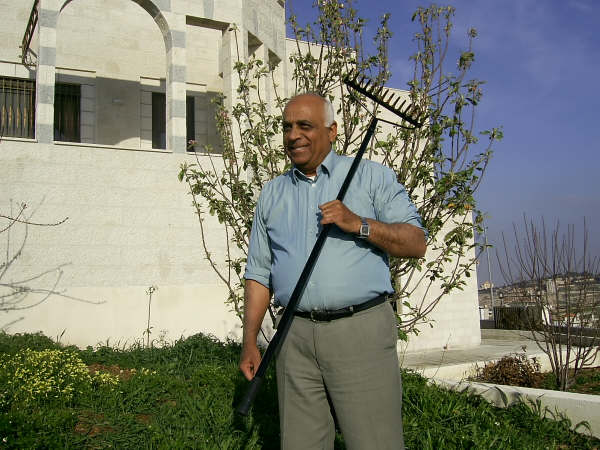
Dr. Abdul-Sattar Kassem was a Palestinian writer, thinker, and academic, and one of the most prominent voices to oppose both the Israeli occupation and the policies of the Palestinian Authority — a stance that brought him a long record of persecution and detention from both sides over the course of his life.
Early Life and Education
Abdul-Sattar Kassem was born on September 21, 1948, in the town of Deir al-Ghusun in the Tulkarm district, then under Jordanian administration of the West Bank. He completed his primary education in Deir al-Ghusun and his secondary education at al-Fadhiliyah School in Tulkarm, finishing high school in 1967 amid the circumstances of the June War that year.
He enrolled at the American University in Cairo in 1968 and graduated in 1972 with a bachelor’s degree in political science. He then pursued graduate studies in the United States, earning a master’s degree in political science from Kansas State University, followed by two more degrees from the University of Missouri: a master’s in economics and, in 1977, a Ph.D. in political philosophy.
Academic Career
He held Jordanian citizenship until 1988, after which he became a Palestinian citizen. He worked as an assistant professor at the University of Jordan from 1978 to 1979, before his position there was terminated for political reasons following Israel’s invasion of southern Lebanon. He then moved to An-Najah National University in Nablus, where he taught as professor of political science and Palestinian studies from 1980 until his retirement in 2013, alongside part-time teaching stints at Birzeit University and Al-Quds University.
Intellectual Output
Dr. Kassem was one of the most prolific Palestinian writers and researchers of his generation, authoring roughly 25 books and more than 130 academic papers, in addition to thousands of newspaper columns, on political philosophy, Islamic thought, resistance, corruption within the Palestinian Authority, and the Palestinian cause at large. His book titles include Traditional Political Philosophy, The Fall of the King of Kings (on the Iranian Revolution), The Martyr Izz al-Din al-Qassam, The Golan, The Detention Experience, Days in Negev Detention, Freedom of the Individual and Community in Islam, Women in Islamic Thought, Our Father Abraham and the Covenant with the Children of Israel, The Road to Defeat, A Summary of the Palestinian Cause, and Graves of the Arab Thinkers. He received the Abdul Hamid Shoman Award for Young Arab Researchers in Political Science in 1984.
Political Positions
Kassem identified intellectually with the Arab nationalist current, and held unyielding political positions that never softened toward any settlement with Israel — he opposed the Oslo Accords and rejected any concession of Palestinian rights, and was a fierce critic of the Palestinian Authority and its security services, particularly what he described as their security coordination with the occupation. Among his most widely quoted remarks on the subject, he said that Palestinian security services had arrested a Hamas military official in Hebron “led by an Israeli officer,” calling it “a great betrayal and a crime against the Palestinian people and all of Arab history.”
Kassem ran as a candidate in the Palestinian presidential election held in early 2005, announcing his candidacy in November 2004 before withdrawing from the race that December.
Persecution and Detentions
His outspokenness brought him decades of continuous persecution from both the Israeli occupation and the Palestinian Authority. On the Israeli side, he was barred from travel starting in 1981, placed under administrative detention four times during the First Intifada (1987–1993), and had his homes in Nablus and Deir al-Ghusun raided by occupation forces on more than one occasion; he was also detained for a week during the 2014 war on Gaza, and in August of that year survived an armed attack by three masked men in a vehicle bearing Israeli plates, one of whom fired two shots that missed him.
On the Palestinian Authority side, he survived an assassination attempt in 1995 in which he was shot four times, an attack attributed to Palestinian intelligence services. He was detained by the Authority on several occasions in 1996, 1999, 2000, and 2008 — including his 1999 arrest alongside other intellectuals and activists over his signing of the “Statement of the Twenty,” which called on the late President Yasser Arafat to pursue political reform and combat corruption. His car was repeatedly targeted with arson and gunfire: it was burned in Tulkarm in 2005, shot at in June 2007, bombed outside his home in Nablus in January 2009, and burned again near his home in Nablus in 2014.
He was also arrested in April 2009 over remarks he made on satellite television, and around the same time faced a defamation lawsuit filed by two Nablus residents that dragged on for about a year and a half before a court acquitted him in November 2010. In August 2011 he was suspended from his position and held for 48 hours following a complaint from An-Najah University’s then-president, Rami Hamdallah, over an article Kassem had written criticizing the university’s administration, before being cleared and reinstated that October. In February 2016 he was arrested on charges of calling, on television, for the execution of Palestinian leaders — an accusation he denied, stating he had never called for anyone’s death.
Death
On January 9, 2021, Dr. Abdul-Sattar Kassem was diagnosed with COVID-19, and was hospitalized on January 15. That same day, his older brother, Fayiq Tawfiq Kassem, died of the virus at the Red Crescent Hospital in Tulkarm. Abdul-Sattar Kassem was later transferred to An-Najah National University Hospital in Nablus, where he died on February 1, 2021, at the age of 72, from complications of COVID-19. He was buried the following day in his hometown of Deir al-Ghusun.
He is survived by his wife, Amal Faisal Al-Ahmad, his sons Muhammad and Faisal, and his daughters Mays and Samah.